Climate-Induced Displacement and Urban Resilience: A Case Study of Flood-Affected Communities in Punjab.

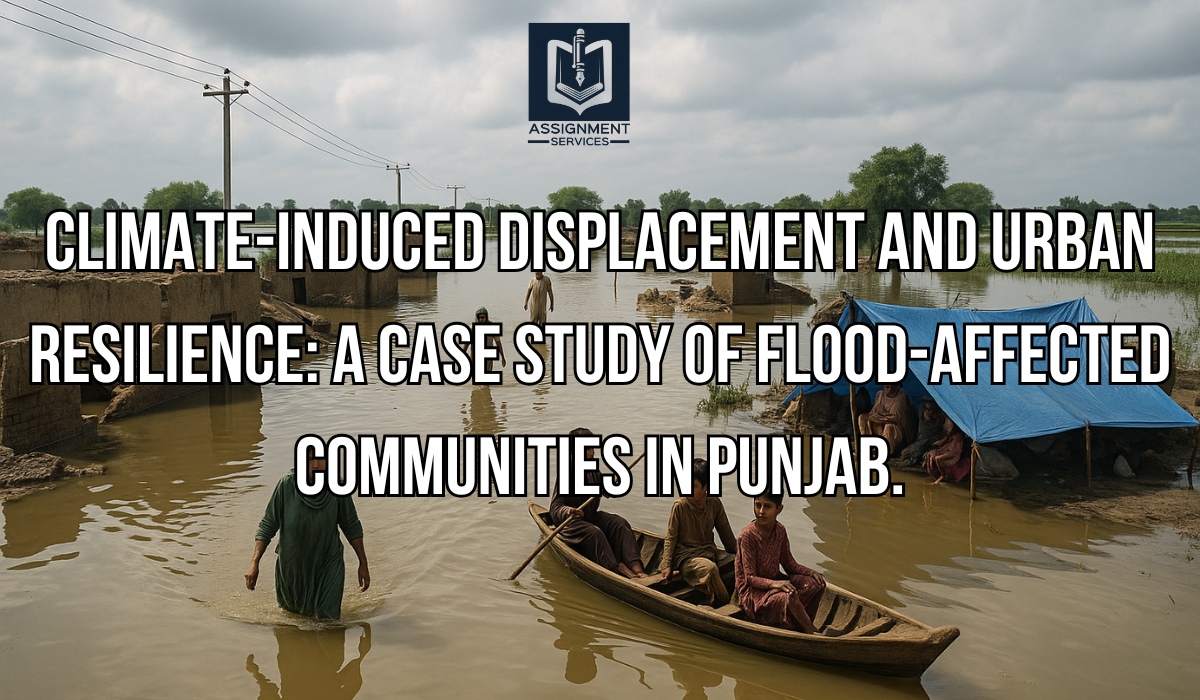
Climate change is one of the most emerging challenges of the twenty-first century. Globally, communities are being reshaped, and economies are being disrupted due to floods, climate change, and rising sea levels. Climate-induced displacement is one of the most serious consequences of climate change. It forces millions of people to leave their homes in search of safety and survival. According to the Internal Displacement Monitoring Centre (IDMC), approximately 20 to 25 million people leave their homes each year due to climate-related events.
In South Asia, Pakistan is facing rapid climate change. Pakistan heavily relies on agriculture; Punjab, the country's main agricultural hub, repeatedly suffers from floods. Following the 2010 flood, the 2022 monsoon destruction, and the 2025 flood, Punjab is facing a recurring cycle of destruction.
The article in the dissertation writing explores the climate induction and resilience in Punjab flood-affected communities. The primary objective is to identify the causes, consequences, and coping strategies of immigrants affected by severe flooding. And check how urban areas respond to it, how they assist people suffering from floods. A case study helps us understand the reality and government policy regarding flood-affected families.
Literature review:
· Shifting grounds:
Climate induction is studied in human rights, environmental science, and migration studies. Recent studies have been conducted by these specialists. The Intergovernmental Panel on Climate Change (IPCC) warns that millions of people’s lives are at risk due to sea level rise, floods, and drought.
· Flood in Punjab:
Punjab has experienced numerous floods in 2010, 2014, 2022, and 2025. These floods cause widespread destruction of waste in Punjab. Pakistan’s economy is heavily dependent on agriculture; these floods can destroy fields, animals, houses, and human lives.
· South Asia:
South Asia has faced massive displacement. Bangladesh has suffered from a large number of migrations due to riverbank erosion, India has faced cyclones, and Pakistan has faced many floods due to rising sea levels. Punjab faced massive destruction due to the Indus, Ravi, and Chenab rivers.
· Designing cities for survival:
Cities are designed in such a way that, in the event of an emergency, they can be utilized to save lives. Good hospitals, housing, drains, roads, social network, and government policies; all these are essential for resilience. In Pakistan, residence is unevenly distributed among areas. Main cities have good and advanced infrastructure, while rural areas struggle to access basic resources and infrastructure.
Theoretical framework:
This study shows three frameworks.
Resilience theory: Looking at the infrastructure and community of the area.
Climate justice: Shows how rural areas are affected most by any natural disaster. How they have no resources to cope with these problems.
Governance theory: Study how government policies and NGOs work together to help people recover from disasters.
Methodology:
This article has a case study approach. Punjab’s Rajanpur, Dera Ghazi Khan, and Muzaffargarh districts were severely affected during the 2010, 2022, and 2025 floods.
Data sources included:
Ø Data from NMDA and agencies for flood protection.
Ø Stories and data shared on the media.
Ø Relying on international media.
Ø Report from different research.
Case Study: Flood-Affected Communities in Punjab.
Displacement in numbers:
In the 2010 floods, nearly 20 million people were displaced, with Punjab experiencing the highest displacement. This flood has destroyed the farmlands, houses, and many lives. In 2022, an estimated 8 million people were displaced. This flood affected the most regions of southern Punjab.
Recently, the 2025 flood displaced almost 1.2 million people. It has destroyed farmlands, houses, animals, and many lives. It mainly affects the Punjab. The lands of Muzaffargarh and Rajanpur are completely destroyed.
How people move:
Flood-affected people migrate from their areas to cities like Faisalabad, Lahore, and Multan. Many people didn’t find a better place to live; they don’t have proper sanitation, clean drinking water, or secure lives. This vast migration can affect cities, which are already overloaded, having limited space and water for use.
Challenges:
After a flood, people face many problems that disturb their whole generation:
· Lives: Many people lose their loved ones in front of their eyes; this remains as a trauma in their heads. Many children lose their parents; these losses are irreplaceable.
· House: People lose their houses; they are now living in a slum because they can’t afford a new house.
· Health: Flood doesn’t only affect the people within the area; it also affects the surrounding areas. After floods, many infections spread. Like malaria, dengue, etc.
· Education: Children who face floods lose everything; they leave their school and migrate to a new place.
· Dishonour: Migrants are often seen as outsiders, and they are discriminated against by society.
Coping strategies:
People can cope with a flood by using these strategies:
· People seek help from local residents
· Many locals provide free aid
· Medical services for flood-affected people
· Temporary housing, such as tents, shelters
· Rely on government and NGOs for help.
Why did Punjab cities fail to hold out against floods?
Infrastructure and planning:
Billions of rupees are spent on building this infrastructure and similar projects, but all these efforts fail when tested. This is all because of our corrupt politicians. They said that they have spent a million on Punjab, but Punjab’s condition is vulnerable. The 2025 flood exposes all they say. Lahore’s drainage system stops working after an hour in heavy flooding, resulting in its roads being turned into rivers. They spend money on their showcase instead of using this money for people’s welfare.
How the system works:
The National Disaster Management Authority (NDMA) and the Punjab Disaster Management Authority (PDMA) are responsible for response in any crisis. Instead of providing services to prevent people from being affected by a disaster, they collected money to help people after the flood. Government systems are so slow that they lack effective coordination with each other.
Even in distributing the aid, favouritism is done. They prefer people who support their parties.
NGOs and civil society:
This is the reality of our country that in any time of disaster, the first ones to provide help are our NGOs or civil societies. In 2025, NGOs such as Alkhidmat and the Edhi Foundation, along with international aid, provided assistance to the people, including food, shelter, and medical facilities. While our government is busy with international tours and struggling with paperwork.
Strengths and weaknesses:
· Strengths: Help from NGOs and communities provides support and helps people to recover quickly
· Weakness: lack of proper urban planning, poor infrastructure, poor savage system, dependence on temporary relief makes Punjab vulnerable. Every year, during the monsoon season, Punjab faces massive floods, highlighting the need for a permanent solution to this issue.
Policy recommendation:
Here are some policy recommendations for coping with natural disasters, such as floods.
· Promote a water management system, and plant more trees to resist the flood.
· Give affordable houses to families who lose their houses in floods to decrease the amount of slums.
· Improve the environment.
· The weather warner should be installed in good condition.
· Educate people about flood and their precautions.
· Get funds from the international climate fund to recover from the loss.
· Involve local people in planning because they better know the problems they are suffering from.
Conclusion:
This article examines the urban resilience and climate factors that contribute to displacement. It highlights how Punjab is struggling with recurring issues due to the absence of effective government-based strategies.
Research and evidence show that Punjab is the most adoptable province due to poor infrastructure and strategies.
The 2025 flood has shown that we can’t afford to remain reactive. Our government should do long-term adaptation and planning for emergencies.